
→ Answers that will help you travel more easily
Frequently asked questions
Traveling with pets
Routes in Lithuania
Animals may be transported on intercity buses in a designated container* whose total dimensions do not exceed 120 cm.
It is prohibited to transport animals in vehicles without a container, with the exception of guide dogs accompanied by their owners (Rules for the Carriage of Passengers and Luggage by Road, Article X, Paragraph 70).
* The carrier (with a total dimension of up to 120 cm) can be of any type—a plastic crate, a leather or woven basket, etc.—as long as the animal is securely contained and cannot escape.
International routes
EUROLINES route Kaunas–Riga
You may bring a pet on board provided the following conditions are met:
- Pets must be transported in a carrier*, and if they do not fit in it, they must wear a muzzle (except for service dogs with documentation);
- A bus ticket costing 50% of the full price must be purchased for the pet (discount option: children aged 0 to 12);
- Pets must be kept on a leash no longer than 0.5 m;
- Passengers traveling with a pet must ensure the pet’s hygiene and are responsible for any damage caused by the pet or any inconvenience caused to other passengers.
Other EUROLINES routes
According to the carrier’s rules, animals are not permitted on board, with the exception of guide dogs accompanied by their owners.
A person with a disability has the right to travel by bus with an assistance dog if they have:
- a document certifying the accreditation of the service dog;
- documents confirming the dog’s health status and vaccination records;
- the animal’s passport.
* The carrier (with a total dimension of up to 120 cm) can be of any type—a plastic crate, a leather or woven basket, etc.—as long as the animal is securely contained and cannot escape.
The pet must meet the requirements set by the Food and Veterinary Service.
Microchip (identification)
The animal must be microchipped with a microchip that complies with ISO 11784/11785 standards.
Rabies vaccination:
- The animal must be vaccinated against rabies after the microchip is implanted;
- An animal that has been vaccinated for the first time may travel only 21 days after vaccination;
- Booster shots must be administered on time to maintain the vaccine’s effectiveness.
European Union Pet Passport:
- a mandatory document indicating the animal’s microchip number, the date of rabies vaccination, and the veterinarian’s details;
- The passport is valid for the animal’s entire life, provided that vaccinations are kept up to date.
Age restrictions:
- Some countries have additional restrictions regarding the age of the animal being transported.
- It is also prohibited to import animals aged 12–16 weeks if 21 days have not elapsed since vaccination.
* The carrier (with a total dimension of up to 120 cm) can be of any type—a plastic crate, a leather or woven basket, etc.—as long as the animal is securely contained and cannot escape.
The carrier (with a total dimension of up to 120 cm) can be of any type—a plastic crate, a leather or woven basket, etc.—as long as the animal is securely contained and cannot escape. The carrier must be enclosed but must have openings for ventilation.
Appropriate container:
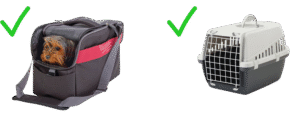
Inappropriate container:

On intercity buses, pets travel with passengers free of charge as long as they do not occupy a seat. If they occupy an additional seat, you must pay 50% of the regular ticket price.
Service dogs may be transported free of charge and do not need to occupy a seat.
IMPORTANT! The pet owner or the person traveling with the pet must provide the required transport carrier and muzzle, and is responsible for the pet’s hygiene, as well as any damage or inconvenience caused by the pet to other passengers.
Service dogs may be transported free of charge and do not need to occupy a seat.
A blind person may travel on public road transport with a guide dog only if they have documents certifying the dog’s health status and vaccination records.
Only healthy animals not intended for agricultural purposes may be transported by bus or train.
You may travel with pets in 2nd and 3rd class compartments.
For more detailed information, we recommend contacting the carrier directly.
IMPORTANT! The pet owner or the person traveling with the pet must provide the required transport carrier and muzzle, and is responsible for the pet’s hygiene, as well as any damage or inconvenience caused by the pet to other passengers.